
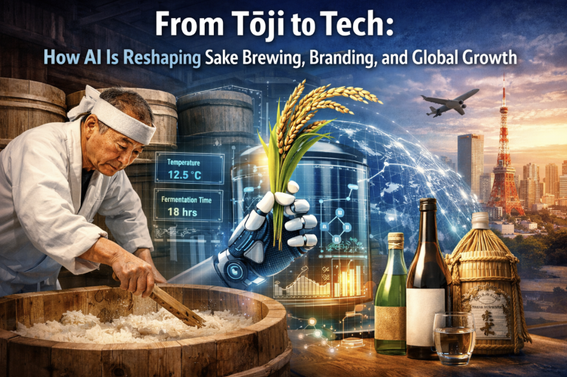
The Japanese sake industry, rooted in centuries of craftsmanship, is quietly undergoing a technological revolution. Artificial Intelligence (AI) is no longer limited to Silicon Valley or robotics labs, it is now shaping how sake is brewed, marketed, distributed, and enjoyed.
From rice polishing to global branding, AI is helping breweries stay competitive while preserving tradition.
1. AI Enhances Fermentation Management
Modern sake brewing requires precise control of fermentation conditions. AI can monitor temperature, sugar levels, and pressure to optimize quality and consistency.
Yokogawa Electric Corporation and Kyoto Brewer Craft Bank have successfully completed a proof-of-concept test applying an AI-guided fermentation optimization system to brewing, using real-time data from sensors to adjust fermentation temperature for consistent results. The reinforcement learning-based AI generated a temperature schedule that, when manually implemented by brewers, shortened the fermentation process by approximately 28% (from 336 to 240 hours) without compromising quality.
This experiment demonstrates how AI can support precision and efficiency in traditional fermentation processes by proposing optimal conditions that reduce trial-and-error. The collaboration highlights the potential for advanced AI technologies to enhance productivity, reduce waste, and maintain product standards in food and beverage production. Overall, the initiative exemplifies how partnerships between technology firms and traditional producers can accelerate innovation and bolster competitiveness in Japan’s industrial landscape.
2. Predictive Modeling Helps Brewers Improve Production
Brewers with decades of expertise are partnering with tech firms to model and predict brewing outcomes.
Asahi Shuzo (the maker of Dassai) conducted a joint field trial with Fujitsu and Fujitsu Laboratories using a predictive AI model designed to support the sake brewing process. This system combined a mathematical model of brewing with machine learning trained on brewing data to help optimize conditions during fermentation and improve consistency and quality.
3. AI Supports Quality Consistency and Scaling
Large datasets allow breweries to stabilize brewing results across batches, reducing variation that could undermine premium branding.
NEC is applying digital transformation (DX) technologies to support traditional sake brewing by helping breweries preserve craftsmanship and maintain consistent quality. Using the NEC Sake Moromi (Sake Mash) Analysis Cloud Service, detailed brewing data such as fermentation time, temperature, and ingredient measurements are digitized and visualized, enabling better monitoring, training of new brewers, and consistent results even when the master brewer changes. The service was developed with direct input from brewers to respect their craft, and it has been adopted by multiple leading sake producers. This effort aligns with NEC’s broader purpose of creating social value and supporting sustainable cultural traditions.
4. AI Records and Preserves Master Brewer Knowledge
Traditional tōji (master brewer) skills are invaluable, but generational workforce shifts make knowledge transfer challenging.
Some breweries actively use generative AI systems to capture brewing expertise and operational judgment for future training. AI can capture and document the decisions and techniques of master brewers (tōji), effectively preserving their expertise in data form. This makes AI a useful tool for passing traditional brewing knowledge on to future generations, especially important given the aging population of expert brewers.
5. Image Recognition Aids Process Control
Brewers are applying machine vision to traditionally subjective steps, like rice soaking and judging visual fermentation cues.
Nanbu Bijin Brewery f.e. has experimented with image recognition to mimic master brewers’ visual (judgment) during crucial steps like rice soaking. Specifically, the brewery has started a pilot project using AI and image recognition to analyze the shinseki (“soaking”) step, where rice is soaked after washing, a process traditionally judged by the tōji’s experience and intuition. By training deep learning models on images and data such as rice expansion, breakage, color, temperature, and rice type, the brewery aims to accumulate objective data that mirrors craft judgment. Although the AI is not currently intended to replace human brewers, it serves as an assistive tool to augment decision-making and help prevent future loss of traditional expertise.
6. AI Personalizes Consumer Recommendations
E-commerce AI can recommend sake styles based on consumer preferences, similar to music or movie recommendation engines.
Taste and preference prediction tools help consumers find sake that matches their palate online. AI-powered tools like “Yummy Sake,” which recommends bottles based on individual taste feedback, and “Kaorium for Sake,” which allows users to search sake by flavor descriptors, illustrate how artificial intelligence is reshaping the Japanese sake ecosystem beyond production.
7. AI Creates New Culinary Pairings
AI isn’t just for the brewery, it’s also being used to enhance gastronomic experiences.
The Japanese sake brewery in Fukushima, Suzuki Shuzoten, is applying artificial intelligence to improve culinary experiences by analyzing the flavor profiles of locally caught fish and crafting sake that best complements them. By partnering with a Tokyo-based taste analysis firm and using sensor technology to quantify taste components like sweetness, saltiness, bitterness, and umami, the brewery has developed a series of AI-informed sake pairings tailored to specific fish species. This innovation not only enhances traditional sake pairing but also supports local food culture and regional revitalization.
8. AI Helps Drive Sustainability Practices
AI enables smarter resource usage, minimizing water waste, energy use and supporting environmental goals.
Tsunan Sake Brewery in Niigata has implemented a smart brewing system that combines generative AI with fermentation and microbial research to analyze production data and support more efficient and environmentally considerate brewing processes. This system uses AI to interpret complex fermentation and environmental data, enabling brewers to adjust conditions in ways that can reduce waste, respond better to climate variations, and ultimately support a more sustainable operation. While specific water or energy reduction figures are not publicly quantified yet, the brewery frames the initiative as helping achieve both quality improvement and sustainability goals by enabling efficient process control and resilience in production challenges.
This example directly ties AI into sustainable brewing strategies by enabling deeper data insights that can reduce environmental impact and help manage variable natural conditions, a key part of minimizing resource waste and supporting long-term operational sustainability in sake production.
9. AI Helps Breweries Overcome Language Barriers and Strengthen Global Marketing
As sake continues to expand internationally, language and cultural barriers remain a major challenge, especially for small and mid-sized breweries with limited global marketing resources. AI-powered translation, localization, and content generation tools are increasingly helping breweries communicate more effectively with overseas markets.
AI can assist with:
- translating product descriptions, tasting notes, and brewery stories into multiple languages
- adapting marketing messages to different cultural contexts rather than direct word-for-word translation
- generating consistent multilingual content for websites, e-commerce platforms, and social media
- supporting export documentation, labeling, and customer communication
By lowering the cost and complexity of multilingual communication, AI enables breweries to tell their stories globally, reach new audiences, and compete internationally without losing the nuance of their brand identity or craftsmanship.
Sake is more than a beverage, it's a symbol of heritage. What makes this transformation exciting isn’t the tech itself, but how AI amplifies craftsmanship instead of replacing it. Brewers are using AI to reduce risk, preserve master brewers’ expertise, refine quality, and expand global reach, without compromising identity.
Bastian
Dr. Bastian Schwithal
Go-Sake